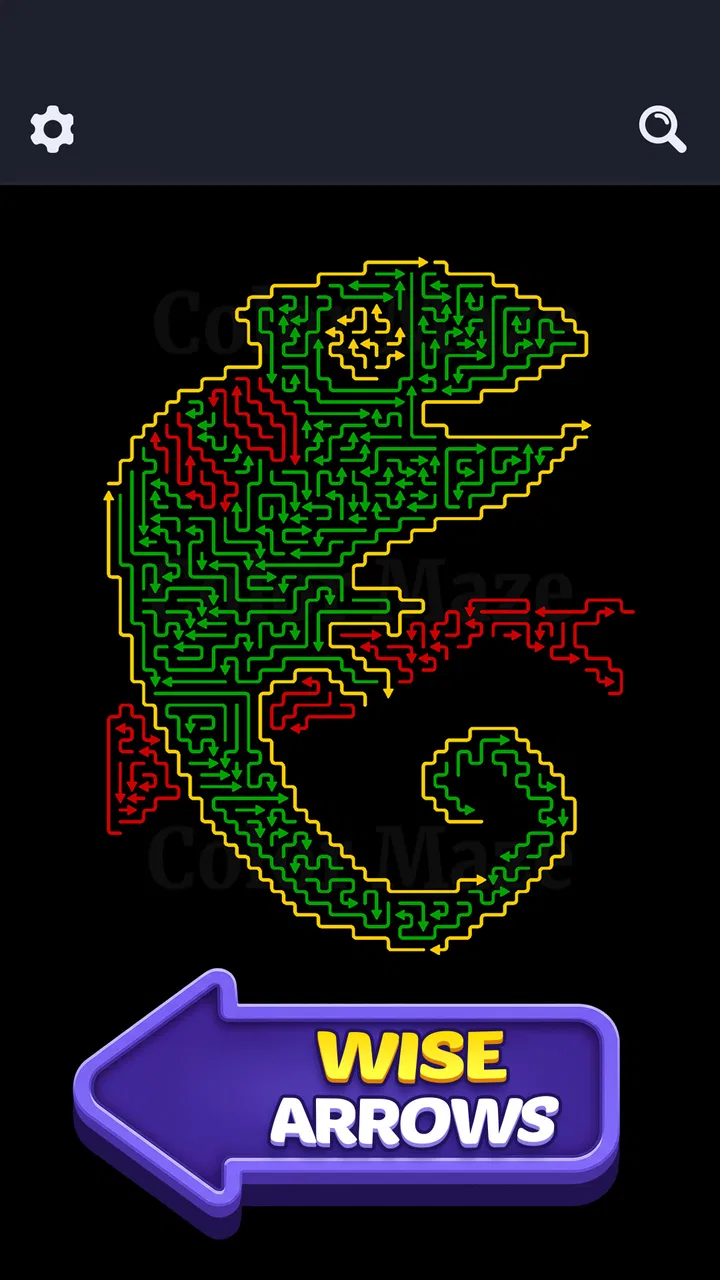
Color Maze
- 4.8
- Rating
- 5.00M
- Installs
- Free
- Price

 Analysis by App-foxy
The first thing I noticed in Arrowscapes™ - Arrows Puzzle is how quickly it gets to its central idea: I look at a board of arrows, choose one, and try to pull the pieces away in a direction that keeps the puzzle moving. That opening action is simple, but it is not mindless. Every arrow is connected to the surrounding arrangement, so one careless tap can leave me staring at a blocked path and reconsidering the order from the beginning.
That makes this a particularly approachable casual puzzle game. I do not need a long tutorial or a complicated control scheme before playing. The challenge comes from reading the board, predicting what will become available, and making a clean sequence of moves. It feels suitable for a short break, yet some layouts ask for enough concentration that I naturally stay longer than planned.
Beijing Youyoutang Technology Co.,ltd. has built the experience around a very focused interaction rather than a crowded collection of modes. The store presents it as Arrowscapes, and that concise identity matches the way it plays: the arrows are the subject, the movement is the tool, and the arrangement is the puzzle. It is free to play and carries an Everyone age rating, which makes it easy to recommend for shared casual use, although younger players may still need patience when a board becomes less obvious.
You May Also Like

 Google Keep - Notes and lists
Google Keep’s Quiet Growth Shows the Appeal of Simpler Notes
As mobile work gets busier, Google Keep keeps winning a simple contest: capture a thought quickly, find it later, and get on with the day.

 Blood Strike: 2.5 Anniversary
Blood Strike’s Loadouts Turn Every Drop Into a Tactical Gamble
A close look at Blood Strike’s custom loadouts: how fast access to signature weapons reshapes its battle royale rhythm, rewards preparation, and narrows the gap between fights.

 Pandora - Music & Podcasts
Pandora’s Music Is Easy to Start, but Harder to Recover
Pandora’s strength is its low-effort path from a seed to a station. Its weak spot is how much confidence it asks you to place in connection, setup, and quiet recovery.

 8 Ball Pool
 Is Built on Rivalries, Rematches, and Routine
A close look at the rivalries, rematches, shared routines, and unanswered safety questions that turn a quick pool match into a persistent mobile community.

 Samsung Music
’s Quiet Strength Is Playing What You Already Own
Its reach comes less from spectacle than from dependable access to a personal library. That simplicity is both the app’s strongest retention engine and its ceiling.

 AccuWeather: Weather Radar
AccuWeather Review: A Quick, Clear Forecast for Everyday Decisions
For everyday plans, the best forecast is the one you can understand quickly. AccuWeather makes rain timing, radar, and local conditions easy to act on, with a few trade-offs.
More From Our News Desk



Why the first move matters more than it looks
My first useful habit was to stop treating the most visible arrow as the best starting point. At a glance, I wanted to tap whichever piece seemed to have the clearest route. In practice, I got better results by scanning the whole board first. I look for arrows whose direction is already open, then check whether removing one will expose another useful route rather than merely creating an empty space.
This small change turns the game from repeated guessing into a light planning exercise. The action remains immediate, but the decision behind it becomes more deliberate. I am not solving a huge abstract problem; I am arranging a short chain of sensible choices. That balance is the strongest part of the design because it gives each tap a visible purpose without making the game feel like homework.
The board also creates a useful tension between local and global thinking. A move can look correct because it clears one corner, while the better move may be on the opposite side because it opens several future options. I found that checking the edges before the middle often helped me understand the structure. This is not a rule that solves every layout, but it is a practical way to avoid spending the opening moves on pieces that do not improve the overall position.
Another helpful approach is to identify the arrows that appear to depend on one another. If one piece is blocking a route for a second piece, and the second piece seems to be blocking a third, I treat that group as a small chain. I then ask which end can be removed safely. Thinking in chains is more reliable than tapping randomly, especially when the board looks visually busy.
That is where the game feels more thoughtful than many quick matching or endless-tapping alternatives. Those games often reward speed, accumulation, or repeating a familiar gesture. Here, the satisfaction comes from seeing the order correctly. The first action is not valuable because it is fast; it is valuable because it makes the next action easier to understand.
The feedback rhythm keeps the puzzle readable
Once I make a good move, the game gives me the most important kind of feedback for this format: the board changes in a way I can immediately interpret. An arrow leaves or shifts the available space, and the newly exposed arrangement tells me whether my plan is working. I do not have to wait for a complicated result screen to know that a choice was useful.
I especially like this rhythm of action, visual change, and renewed inspection. It creates a steady pace. I choose an arrow, watch the path resolve, then pause for a brief read of the new board. That pause matters because it prevents the experience from becoming a sequence of automatic taps. The game encourages me to stay involved in the puzzle rather than simply repeat the last successful gesture.
When I make a poor choice, the feedback is equally useful. A blocked route or an awkward remaining arrangement tells me that the earlier order was wrong. The game’s challenge is therefore communicated through the state of the board itself. I can often diagnose the mistake by asking which arrow I removed too early and which dependency I failed to notice.
For everyday play, this clear rhythm is more important than elaborate presentation. I can pick it up while waiting for a coffee, during a short commute break, or at the end of the day when I want something gentler than a competitive game. A typical session can begin with a quick “just one puzzle” intention, then continue because the next board looks close to solvable. The feedback makes that decision feel natural rather than forced.
There is also a useful mental reset between moves. If I rush, I tend to focus on the arrow directly in front of me and miss the wider pattern. If I let the board settle visually and inspect the open directions, I make fewer impulsive choices. My practical tip is to use the short moment after each removal as a checkpoint: identify what opened, what became trapped, and which piece now has the safest route.
This is one of the less obvious strengths of the game. It can function as a small attention exercise without presenting itself as one. I am repeatedly practicing visual scanning, sequence prediction, and error recognition, but the experience remains playful because every correct step produces an immediate change in the scene.
The reward is the solved pattern, not just the finish
The most satisfying reward in Arrowscapes is the feeling that a messy arrangement has become understandable. At the beginning, several arrows may compete for attention. After a few correct choices, the board starts to reveal its logic. When the final obstruction disappears, the pleasure comes from recognizing that the solution was built one decision at a time.
That reward is quieter than the spectacle of an action game, but it suits the design. I do not need a dramatic story or a competitive leaderboard to feel progress. The board itself supplies the payoff. A successful solution confirms that my reading of the paths was accurate, and that confirmation is enough to make the next puzzle attractive.
The game’s broad audience figures also suggest that this simple loop has found a substantial audience: it has passed a million installs, holds an average rating of 4.6 from around 314 thousand ratings, and has about 4.1 thousand written reviews. I would not use popularity as proof that every player will enjoy it, but those figures fit my impression that the concept is easy to understand and rewarding for people who like compact visual puzzles.
The reward is strongest when I solve a board without relying on frantic experimentation. I sometimes test a move simply to learn what it changes, but the better moments come when I have already formed a small plan. The game makes that plan feel worthwhile because the result is visible immediately. In a more conventional casual alternative, I might be chasing a score or a timer; here, I am chasing clarity.
That difference also explains who may not enjoy it. If you want constant action, character progression, competitive pressure, or a large variety of mechanics, this may feel too narrow. Its appeal depends on enjoying the same basic interaction repeatedly while the arrangement changes. Players who dislike restarting a puzzle after a mistaken sequence may also find the experience frustrating, particularly when a board appears nearly solved but one early decision has quietly made completion impossible.
For me, the best use case is a person who wants a low-pressure game that still asks for attention. It works well as a transition activity between demanding tasks because the rules are easy to remember, but the board gives my mind something concrete to focus on. I would also consider it a reasonable shared game for family members with different gaming experience, since the controls are approachable and the challenge can be discussed aloud without requiring specialist knowledge.
Why another session begins after the board is clear
After finishing a puzzle, I usually feel a brief sense of completion followed by curiosity about the next arrangement. That is the reset point in the game’s loop. The previous board is no longer a problem to solve, but the skill I used on it carries forward: scan first, identify dependencies, and avoid spending an important opening move without a reason.
This reset works because the game does not ask me to learn an entirely new control system each time. The novelty comes from the configuration of the arrows. I can begin another session immediately, already familiar with the action but not certain of the solution. That combination is a strong casual formula: low entry cost, fresh short-term uncertainty, and a clear sense of closure when the board is resolved.
In a normal day, I might open it while waiting for an appointment and complete one board. Later, I may return when I want a break from reading or scrolling. The game fits those moments because I can focus on one arrangement without committing to a long narrative or a multiplayer match. At the same time, the “one more” pull is real. A puzzle that ends with an awkward mistake often feels unfinished, so I want to try again and prove that I can find a cleaner order.
My advice for avoiding unnecessary frustration is to treat a restart as information rather than failure. If a board collapses because I chose one arrow too early, I try to remember the dependency that caused the problem. On the next attempt, I do not replay every move automatically; I change the critical decision and watch how the later paths differ. This makes the reset meaningful and helps prevent the game from becoming blind trial and error.
There is a trade-off here. The focused design makes the game easy to return to, but it can also make longer sessions feel repetitive if I am not in the mood for spatial planning. I would choose it over a match-three game when I want a slower, more deliberate puzzle, and over a reflex game when I want to relax. I would choose a richer puzzle adventure instead when I want story, exploration, or a stronger sense of long-term progression.
The current version is 10.1.7, and it runs on Android starting with version 6.0. That makes it accessible across a wide range of Android devices, though the actual comfort of play will still depend on screen size and touch responsiveness. On a smaller display, I would take extra care before tapping a crowded group of arrows, because precision matters more when several paths sit close together.
Small habits that make difficult layouts easier
One technique that helped me was to separate “available now” from “useful next.” An arrow may be completely open, but removing it may not improve the board. I first mark mentally the pieces I can move, then choose the one that reveals the most information or clears a dependency. This prevents the common mistake of confusing permission to move with a good reason to move.
I also try to preserve flexibility early in a puzzle. If two arrows can be removed safely, I prefer the move that leaves more routes visible. That gives me a better position for the following decision. It is a subtle trade-off: the fastest-looking move is not always the safest, and a slightly less obvious removal can keep the board from narrowing too soon.
When I am stuck, I stop searching for the entire solution. Instead, I look for one confirmed relationship: which arrow is definitely blocking another, or which route is definitely open. Solving that small relationship often makes the next part visible. This approach is especially useful for casual players because it lowers the mental load without removing the puzzle’s challenge.
Finally, I avoid tapping through a sequence just because the first two moves worked. The board can change its character after a successful opening. A good early move is not a guarantee that the next obvious arrow is correct. Rechecking the arrangement after each removal takes only a moment and is usually faster than recovering from a careless chain.
These habits are not formal systems that turn every puzzle into a guaranteed solution. They are ways of making the core loop more satisfying. The game remains about reading and adapting, but I feel more in control of my decisions. That distinction matters: a difficult board is enjoyable when I can understand why I am stuck, while a random board feels discouraging when success seems unrelated to planning.
My verdict on the complete action-to-reset loop
Arrowscapes™ - Arrows Puzzle succeeds because its loop is easy to describe but rewarding to repeat. I take an arrow, observe how the board changes, use that feedback to plan the next move, enjoy the clean resolution of the completed pattern, and then face a fresh arrangement. Each stage supports the next one, so the game rarely feels like a collection of disconnected taps.
I recommend it to anyone who likes visual logic puzzles, short sessions, and games that reward patience more than speed. It is especially good for filling small gaps in the day or for winding down with something that keeps the mind lightly engaged. The free price and Everyone rating make it an easy option to try, while the large audience and strong average rating show that its straightforward concept has broad appeal.
I would skip it if your ideal casual game needs constant novelty, social competition, elaborate rewards, or action-focused controls. The narrow arrow-and-path idea is both its identity and its limitation. After extended play, I may want a different genre simply because I have had enough of the same kind of visual decision-making.
For my taste, though, that focus is a virtue. The developer does not need to bury the central interaction under unnecessary complexity. I can understand the first action within moments, learn from each board, and return after a reset without rebuilding my familiarity. The strongest reason to keep playing is the satisfying proof that a careful sequence can turn visual clutter into a clear path.
FAQs for Color Maze
01What is Arrowscapes™ - Arrows Puzzle about?
Arrowscapes™ - Arrows Puzzle is a strategic puzzle game where players navigate through complex grids using directional arrows to reach a target. The game requires critical thinking and planning to maneuver through different levels successfully. It’s designed to challenge your problem-solving skills with increasing difficulty as you progress.
02Is Arrowscapes™ suitable for all ages?
Yes, Arrowscapes™ is designed to be enjoyed by players of all ages. Its intuitive interface and gradual increase in difficulty make it accessible for younger players, while providing enough challenge for adults. However, children under the age of 8 may need some guidance initially to understand the game mechanics.
03Does Arrowscapes™ require an internet connection to play?
Arrowscapes™ can be played offline, which makes it a great option for entertainment when you’re without an internet connection. However, certain features, like leaderboard updates and in-app purchases, will require connectivity to access. This offline capability ensures uninterrupted gameplay wherever you are.
04Are there in-app purchases in Arrowscapes™?
Yes, Arrowscapes™ offers in-app purchases that can enhance your gameplay experience. These may include additional hints, new levels, or cosmetic upgrades. While the game is free to download and play, these optional purchases can provide advantages or customization options for avid players.
05How often does Arrowscapes™ receive updates?
The developers of Arrowscapes™ are committed to providing a fresh and engaging experience by regularly updating the game. Updates may include new levels, bug fixes, and additional features to enhance gameplay. Checking the app store for the latest version will ensure you're always enjoying the newest content.
Pros
- Engaging puzzles with increasing difficulty.
- Intuitive controls enhance user experience.
- Visually appealing with vibrant graphics.
- Regular updates with new challenges.
- Offline play available for convenience.
Cons
- Limited free levels before in-app purchases.
- Occasional ad interruptions during gameplay.
- Requires frequent updates for new content.
- Some puzzles may seem repetitive over time.
- No multiplayer or social sharing options.

Color Maze
Gallery